New Carpet Smell and Off-Gassing: How to Minimize It
New carpet smell comes from VOCs released by the carpet, cushion, backing, and adhesives. Learn how long it lasts, which symptoms to watch for, and how 72 hours of ventilation and low-VOC products reduce it.
The distinctive smell of new carpet comes from volatile organic compounds (VOCs) released by the carpet and other materials used during installation. The carpet backing, cushion, adhesive, seam sealer, and nearby renovation products can all contribute.
Emissions are usually highest during and shortly after installation, then decline over time. Odor is not a reliable measure of risk: some compounds are noticeable at very low concentrations, while others have little or no smell.
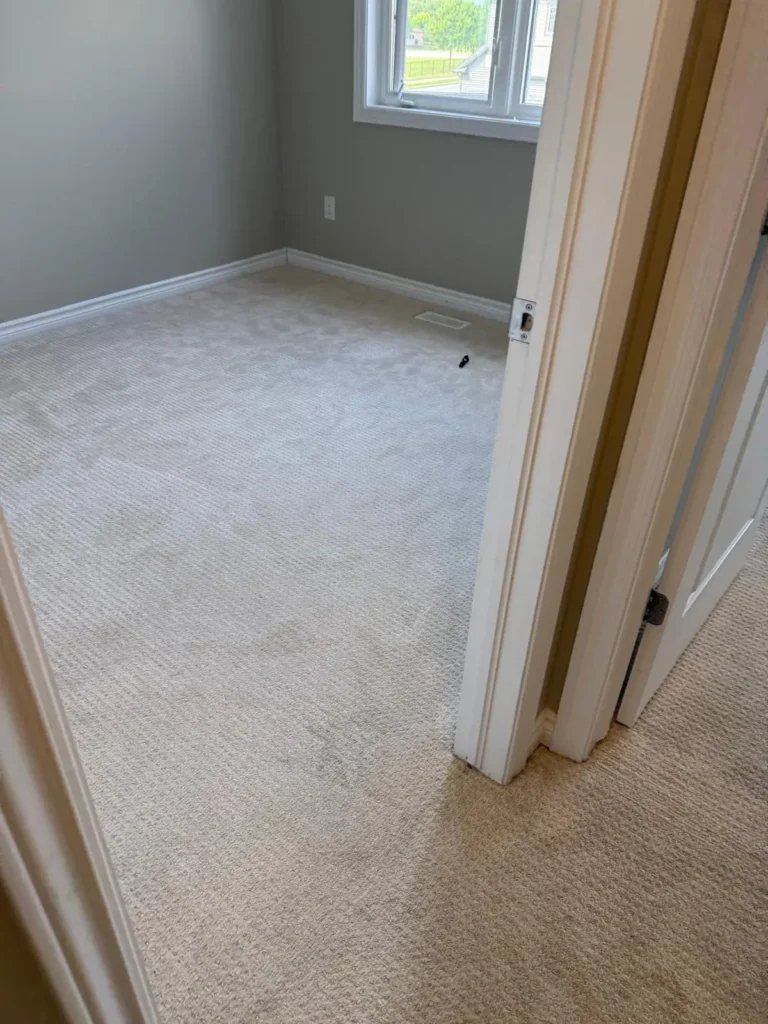
What to Do After Installation
Ventilation is the most effective first step. The U.S. Environmental Protection Agency (EPA) recommends bringing in as much fresh air as practical during installation and for at least 72 hours afterward.
- Open windows on opposite sides of the room, if weather and outdoor air quality allow.
- Place a fan in one window and point it outward to exhaust indoor air.
- Leave another window open to provide replacement air.
- Limit airflow into the rest of the home by closing or positioning interior doors as needed.
- Follow any ventilation instructions provided by the carpet, cushion, or adhesive manufacturer.
If outdoor ventilation is not practical, use an exhaust system or mechanical ventilation that replaces indoor air with outdoor air. Simply running the central HVAC fan may circulate the odor throughout the home without removing its source.
Keep a record of the carpet, cushion, adhesive, seam sealer, and other products used. Product labels and safety data sheets can be helpful if the odor persists or symptoms develop.
What Causes New Carpet Odor?
A carpet installation is a system, so the odor may come from more than one material:
- Carpet fibers and backing
- Cushion or underlay
- Manufacturing and installation adhesives
- Seam sealers and floor-preparation products
- Paint, cabinetry, flooring, or other materials installed during the same project
Research has associated the characteristic odor of some carpets with 4-phenylcyclohexene (4-PCH), a compound linked to styrene-butadiene rubber latex backing. Other carpet products may release different compounds. Studies have detected substances including styrene, formaldehyde, and vinyl acetate, but findings vary with the materials and test conditions.
Smell alone cannot identify a chemical. A noticeable odor does not prove that formaldehyde is present, for example, and a glue-like smell does not necessarily mean the installation adhesive is responsible.
Can Off-Gassing Affect Your Health?
VOCs can irritate the eyes, nose, and throat. Short-term exposure may also cause headaches, dizziness, nausea, coughing, wheezing, or worsening asthma symptoms. The effects depend on the compounds present, their concentrations, the length of exposure, and individual sensitivity.
These symptoms are not specific to carpet emissions. Renovation dust, cleaning products, mold, and outdoor pollutants can cause similar problems.
If symptoms begin in the newly carpeted space, leave the room and get fresh air. Seek urgent medical care for difficulty breathing, chest tightness, fainting, confusion, or other severe symptoms. Contact a healthcare professional if milder symptoms persist or repeatedly return in the room.
People with asthma or chemical sensitivities may prefer to stay elsewhere during installation and the initial ventilation period.
How Long Does the Smell Last?
There is no single timetable. Emissions often fall substantially during the first 72 hours when the space is well ventilated, although some odor may remain longer. Duration depends on:
- The carpet, cushion, and installation products
- Whether the carpet was glued down
- The size of the installation and the room
- Temperature and humidity
- The amount of outdoor-air ventilation
- Individual sensitivity to odor
The smell should generally become less noticeable. Contact the installer if it remains intense after several days of ventilation, grows stronger, appears when the room becomes damp, or is concentrated near a seam or one area of the floor. Those patterns may point to excess adhesive, moisture, contamination, or another installation issue.
Can an Air Purifier Remove Carpet VOCs?
An air purifier may help, but the filter type matters. HEPA filters capture particles such as dust, pollen, and mold spores; they do not remove gaseous VOCs on their own.
Activated carbon and other gas-phase filters can reduce some VOCs. Their effectiveness depends on the compounds present, the amount of filter material, airflow, room size, source strength, and how saturated the filter has become. Many consumer purifiers contain only a thin layer of carbon and have limited capacity.
Use air cleaning as a supplement to ventilation and source control, not as a substitute for them.
Avoid ozone generators. According to the EPA, ozone can harm health, is generally ineffective at removing indoor contaminants at concentrations considered safe, and may react with other chemicals to form additional pollutants.
Choosing Lower-Emission Carpet Products
The Carpet and Rug Institute’s Green Label Plus program tests products in environmental chambers and sets limits for specified emissions. Certification can help identify lower-emitting products, but it does not guarantee zero emissions or no odor.
Carpet, cushion, and adhesive are certified separately, so check each component rather than relying on a general “low-VOC” claim. Before installation, you can also ask whether the carpet may be unrolled and aired in a clean, dry location. Confirm that the installer will use the amount of adhesive specified by the manufacturer.
Approaches That Have Limited Value
- Air fresheners: These mask odor without removing its source and may add VOCs of their own.
- Bowls of baking soda or vinegar: These are not established methods for removing carpet VOCs from indoor air.
- HEPA-only purifiers: These are useful for particles, but not gases.
- Ozone generators: These are potentially harmful and are not recommended for occupied homes.
- Low-cost VOC monitors: These may show general changes over time, but they cannot reliably identify individual compounds or determine whether a room is safe.
When to Contact the Installer
Ask the installer or retailer to investigate if:
- The odor becomes stronger rather than weaker
- It remains intense after several days of good ventilation
- It is concentrated near a seam, adhesive area, wall, or damp spot
- The carpet or cushion became wet
- Several people develop symptoms in the room
- You cannot identify the products used
Provide the installation date, room size, product names, ventilation steps taken, and details about any odor, moisture, or symptoms. Ask the installer to confirm the installation method, adhesive application, subfloor condition, and evidence of moisture.
If the source remains unclear, consider consulting an indoor-air-quality professional with experience investigating building materials. Laboratory testing is most useful when it is designed to answer a specific question. A consumer VOC reading alone usually cannot identify the source.
Frequently Asked Questions
Does Every New Carpet Smell?
No. Odor intensity varies by product and installation. Some lower-emission products have little noticeable smell, but the absence of odor does not prove that there are no emissions.
Can I Sleep in a Newly Carpeted Room?
Ventilate the room thoroughly first, particularly during the first 72 hours. Sleep elsewhere if the odor causes irritation or worsens asthma symptoms.
Does Vacuuming Reduce Off-Gassing?
Vacuuming removes loose fibers and particles, not gaseous VOCs. Follow the manufacturer’s cleaning and maintenance instructions.
What If the Odor Does Not Go Away?
Continue ventilating when it is safe to do so, obtain the exact product information from the installer, and check for moisture or installation problems. Seek professional help if the odor remains strong or symptoms persist.